Mastering 3D Earthwork Cut and Fill Volume Calculations
A step-by-step engineering guide to calculating net site soil balances, swell and shrinkage factors, and preventing budget overruns on civil earthmoving projects.
Key Takeaways for Estimators & Contractors
- ✔Site earthwork miscalculations represent the single largest source of unforeseen financial liability on greenfield and commercial site developments.
- ✔Failing to adjust raw contour volume measurements for soil compaction shrinkage (10–25%) and rock swell factors (20–40%) leads to massive trucking haul budget deficits.
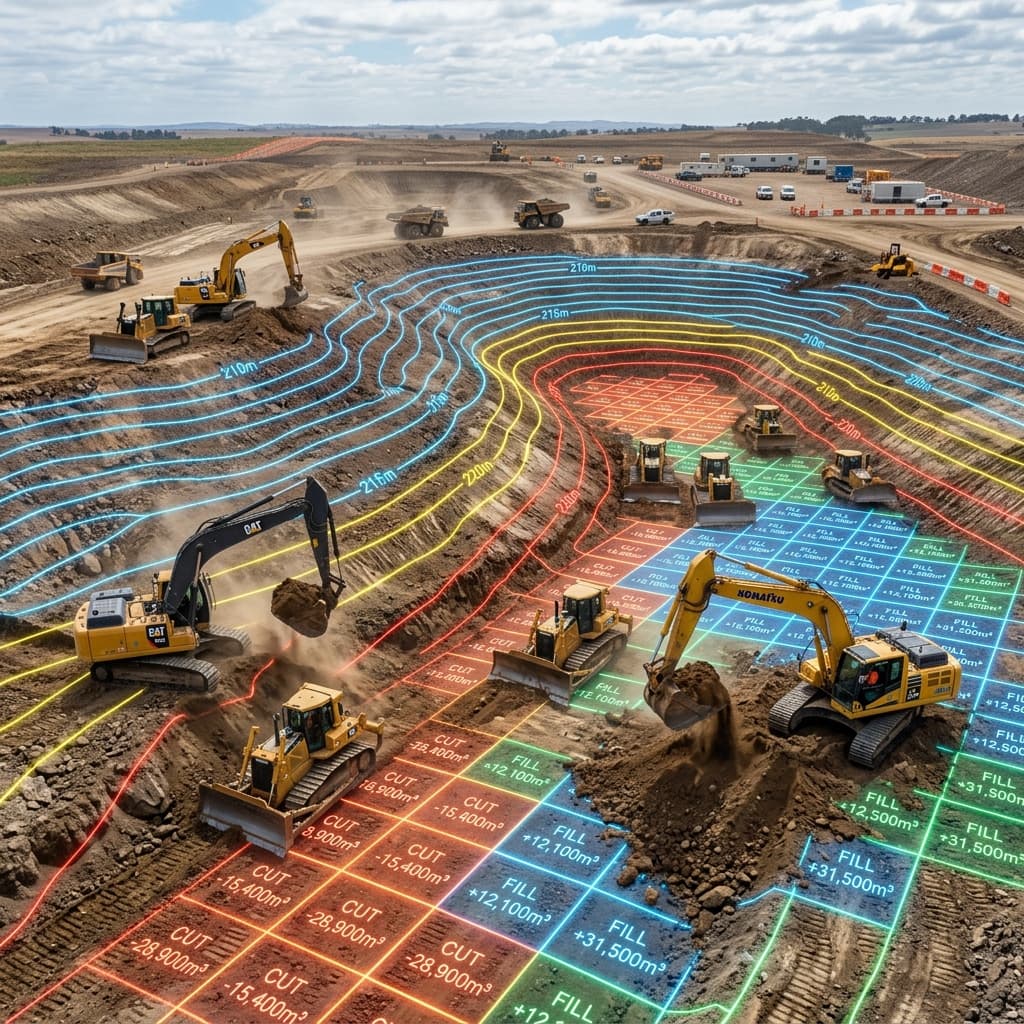
- ✔Modern 3D surface modeling comparing existing topography against proposed finish subgrades delivers exact cut/fill balance boundaries.
Fundamentals of 3D Earthwork Topography in Sitework
Earthwork estimating requires calculating the precise volumetric displacement between the existing ground surface (topographic survey contours) and the proposed final grades (civil grading plan). Whether developing a 50-acre commercial logistics center or preparing a pad for a multi-family complex, misjudging the site balance by even 6 inches across an extensive acreage translates to thousands of cubic yards of unanticipated off-site soil hauling or borrow import.
- •Cut: Soil volume that must be excavated to reach design subgrade elevation.
- •Fill: Compacted soil volume required to elevate low ground to subgrade elevation.
- •Net Balance: The differential between cut and fill. A balanced site minimizes costly material import or export trucking.
Soil Mechanics: Shrinkage, Swell, and Compaction Physics
Bank cubic yards (BCY) in the natural undisturbed state do not behave the same when excavated (Loose Cubic Yards, LCY) or rolled and compacted under vibrating rollers (Compacted Cubic Yards, CCY).
| Soil / Material Classification | Bank Volume (BCY) | Excavation Swell (LCY) | Compacted Volume (CCY) | Net Material Behavior |
|---|---|---|---|---|
| Clean Sand & Gravel | 1.00 BCY | 1.10 – 1.15 LCY (+12%) | 0.90 – 0.95 CCY (-8%) | Minimal net shrinkage |
| Common Earth / Loam | 1.00 BCY | 1.20 – 1.25 LCY (+22%) | 0.80 – 0.85 CCY (-18%) | Moderate compaction loss |
| Dense Heavy Clay | 1.00 BCY | 1.30 – 1.35 LCY (+32%) | 0.78 – 0.82 CCY (-20%) | Significant haul swell volume |
| Solid Hard Rock / Basalt | 1.00 BCY | 1.50 – 1.65 LCY (+55%) | 1.25 – 1.35 CCY (+30%) | Permanent volumetric swell |
Calculation Methodologies: Average End Area vs. Triangulated Irregular Networks (TIN)
Traditional road earthwork relied on the Average End Area method across cross-section stations. For modern multi-elevation building sites with retaining walls, storm detention basins, and parking terraces, we build Triangulated Irregular Network (TIN) surface meshes. By subtracting the proposed finish subgrade TIN from the existing surface TIN, software calculates cut, fill, and transition daylight lines with millimeter precision.
Civil Sitework Estimating Quality Control Checklist
Before issuing earthwork quantities to bidding grading contractors, our civil estimators verify stripping depth deductions (typically 4" to 6" of organic topsoil), asphalt and concrete pavement cross-section thicknesses, building slab aggregate sub-base offsets, and foundation footing spoil volume.
Related Preconstruction Estimating Services
Frequently Asked Questions
What is the difference between Bank, Loose, and Compacted cubic yards?↓
Bank Cubic Yards (BCY) measure soil in its natural in-situ state. Loose Cubic Yards (LCY) measure soil after excavation when it expands with air voids. Compacted Cubic Yards (CCY) measure soil after mechanical rolling and compaction on the fill site.
Why must pavement subgrade be deducted from earthwork volume?↓
Civil plans display finished grade elevations. The grading contractor must excavate below finish grade to allow room for base gravel courses and asphalt/concrete surfaces.